


Introduction
A brake drum order can be produced, packed, and booked on time and still lose days at the port because one document doesn't line up. The problems are rarely dramatic – a vague description, a pallet count that doesn't match, a missing signature, an origin detail that isn't clearly shown. Small things, but any one of them can stop a shipment.
This guide covers the five core export documents behind a Vietnam-to-U.S. brake drum shipment: what each one does, and where delays tend to start.
These are export-side documents — the paperwork the exporter prepares to move an order out of Vietnam, not the CBP entry, security filing, and bond the buyer handles on the U.S. import side.
The 5 Core Export Documents at a Glance
For a standard ocean shipment of brake drums from Vietnam, this is the working set of docs:
| Document | What it does | Who prepares it |
|---|---|---|
| Commercial invoice (CI) | Shows the seller, buyer, goods description, quantity, value, Incoterm, and country of origin. U.S. customs uses it to classify the goods and assess duties. | Exporter (seller) |
| Packing list (PL) | Shows how the order is packed — cartons, pallets, weights, dimensions, and special marks on each package. | Exporter (seller) |
| Export customs declaration (CD) | Clears the goods out of Vietnam through the VNACCS customs system. A separate import entry is filed on the U.S. side. | Exporter / customs broker |
| Bill of lading (B/L) | Acts as the carrier's receipt, the transport contract, and the document of title for an ocean shipment. | Carrier / freight forwarder |
| Certificate of origin (CO) | Confirms where the drums were made, which determines the trade measures applied to the goods. | Exporter; issued via Vietnam's Ministry of Industry and Trade |
The Incoterm doesn't change who prepares each document, only who pays for freight and insurance and who carries the risk. The exporter is responsible for providing the invoice, packing list, and certificate of origin regardless of the term.
1. Commercial Invoice
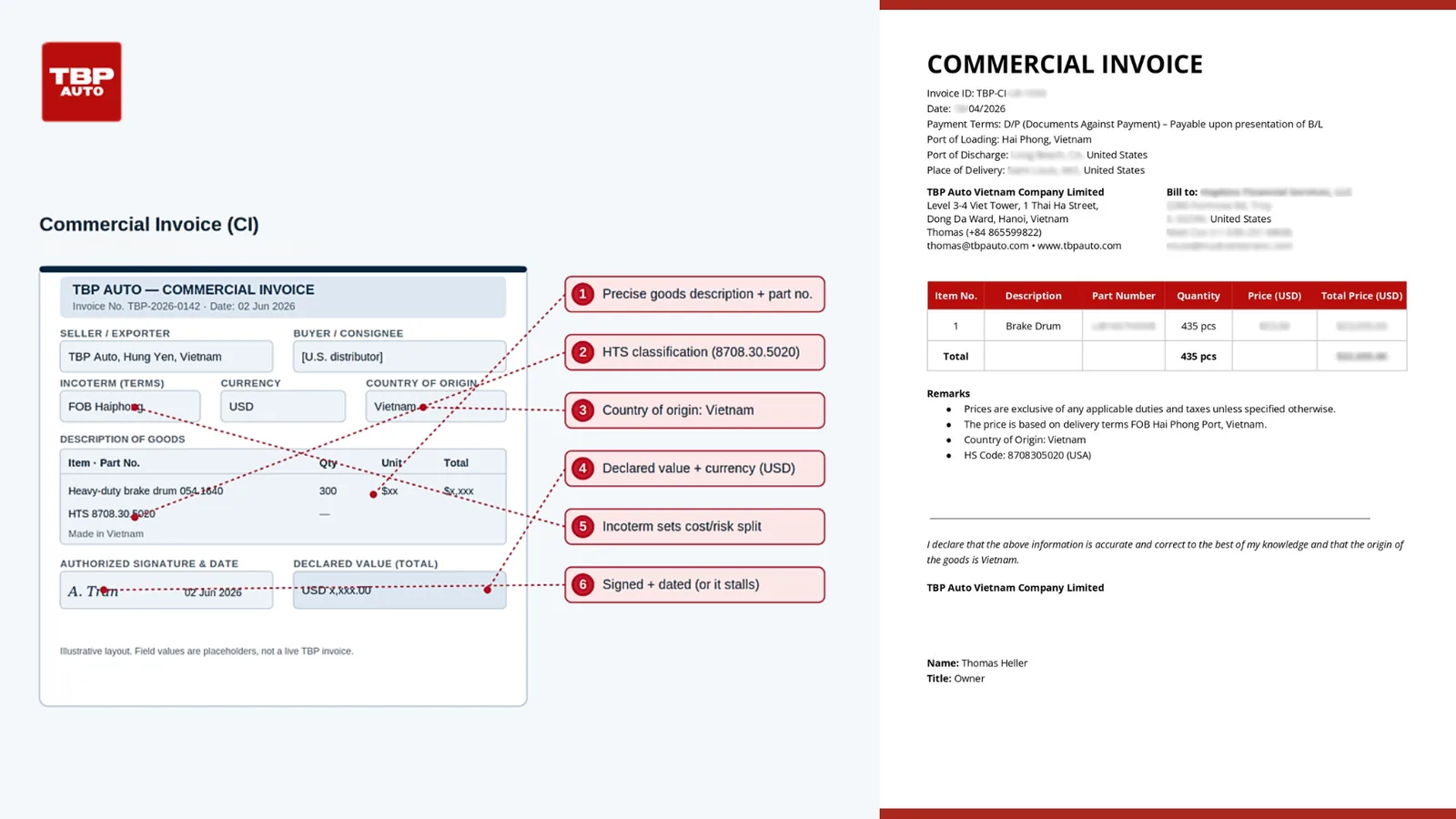
The commercial invoice is usually the first thing customs and brokers read. It works as both a sales record and a customs document, setting out what was sold, who bought it, what it's worth, and where it came from.
For a brake drum order, it should show:
- Parties: seller and buyer details
- Terms: the Incoterm (FOB, CIF, EXW, and so on)
- Description: a specific goods description, such as “heavy-duty brake drum” with the model or part number
- Value: quantity, unit price, total value, and currency
- Origin: the country of origin, usually Vietnam
- Classification: the HS or HTS code used for classification
The description is the line worth getting right. “Metal parts” invites questions; “heavy-duty brake drum” with the correct part number and origin gives brokers and customs what they need to move the shipment along.
The invoice should be in English, signed if required, and dated before it goes out.
Read more → Import Guidelines for Brake Drums to the USA
2. Packing List
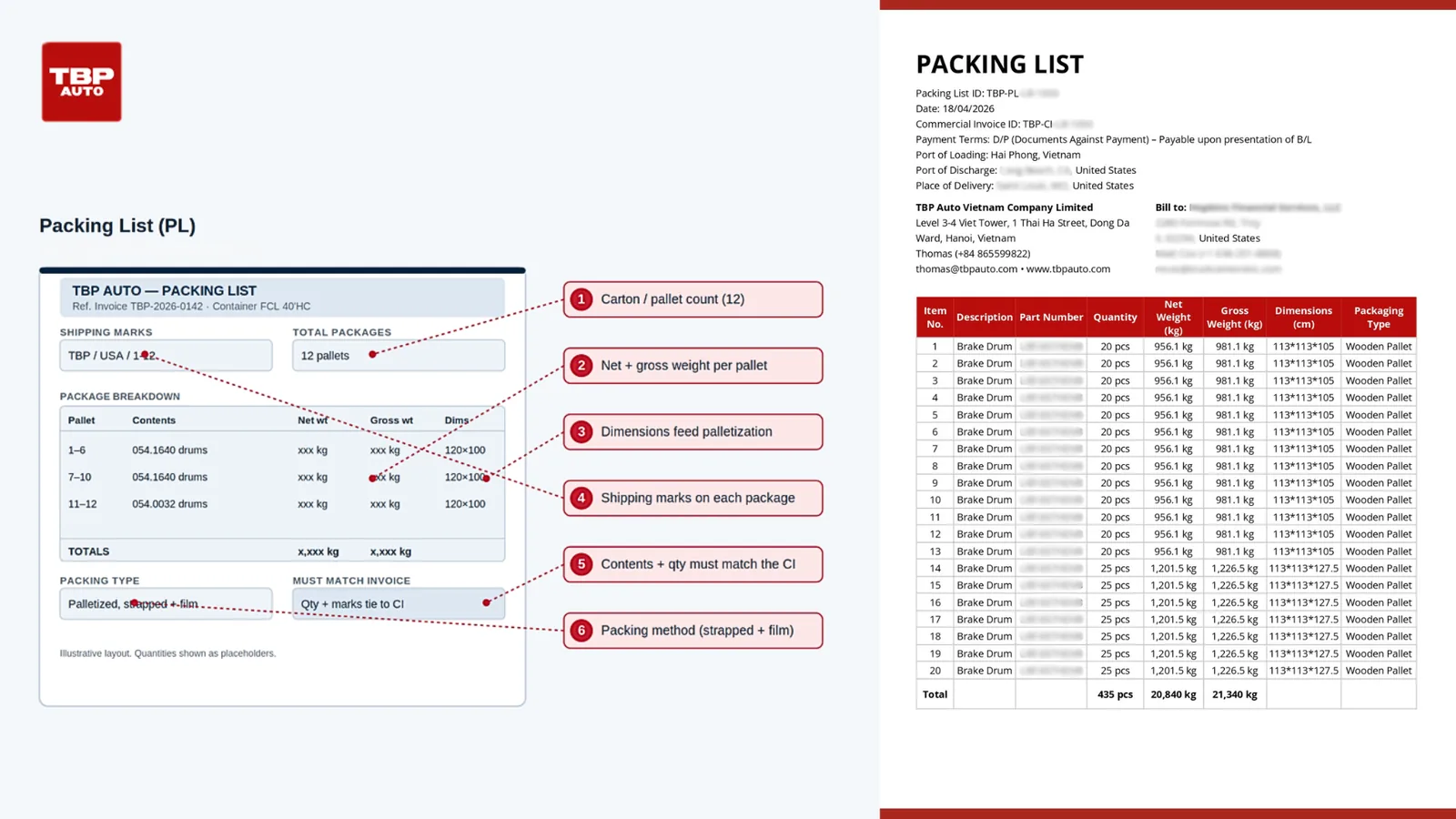
The packing list is the physical side of the order, and for brake drums it's more than a box count. Drums are dense and heavy, so the list shows how the cargo is arranged: how many pallets or cartons, the net and gross weight, the dimensions, and the marks on each package.
Those details facilitate downstream work: freight forwarders use them to plan loading, and customs uses them to check the shipment quickly if an inspection comes up.
3. Export Customs Declaration
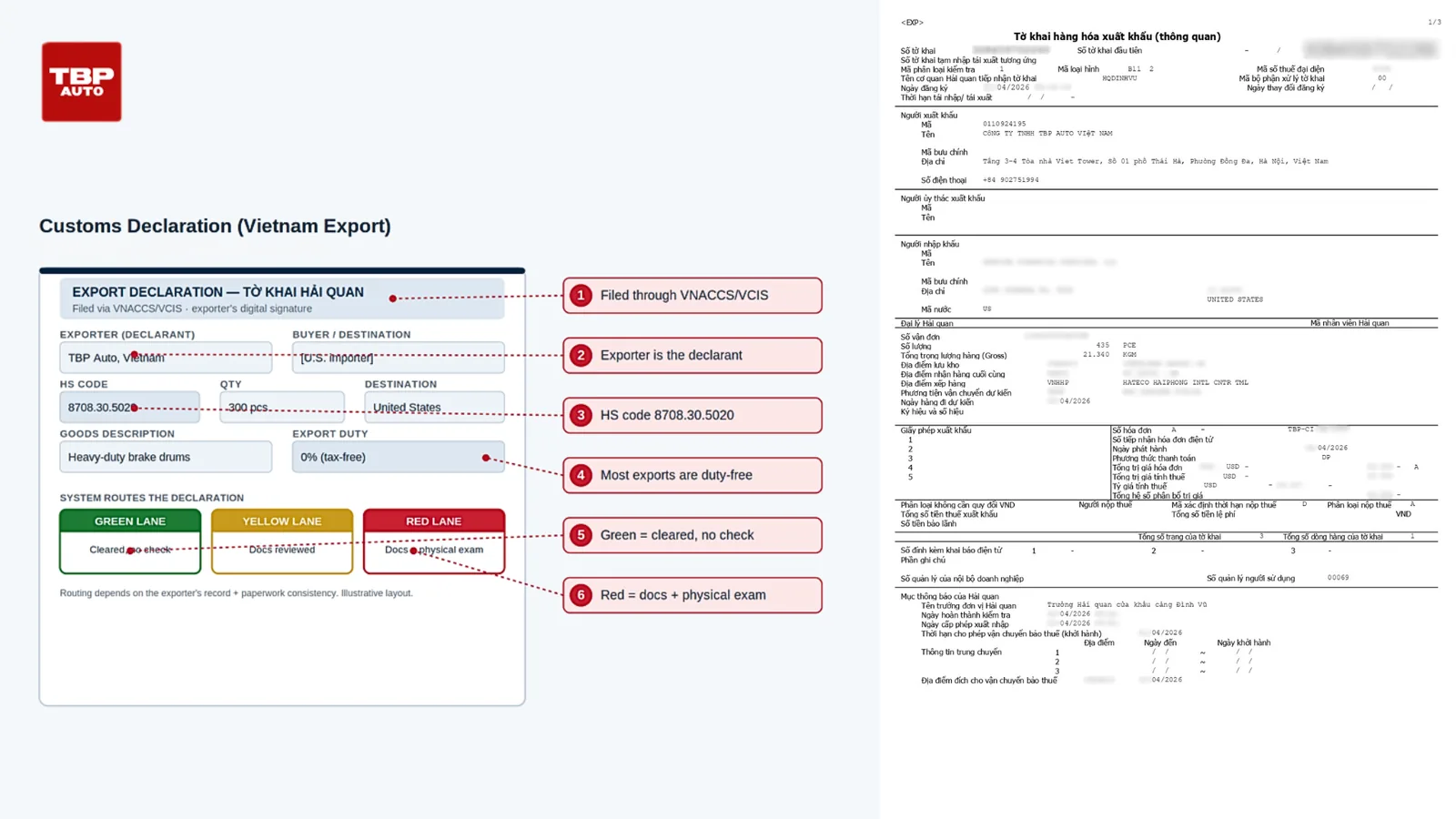
Before the order can leave the country, it must be declared to Vietnam Customs by the exporter or an appointed broker.
It's filed electronically through VNACCS, Vietnam's automated customs system, pulling together the key facts: exporter, buyer, destination, goods description, HS code, quantity, value, and transport details.
The system then assigns a number and sorts the shipment into one of three channels:
- Green channel: cleared without document review or physical inspection — the smoothest outcome.
- Yellow channel: customs reviews the documents before clearing.
- Red channel: customs reviews the documents and physically inspects the goods.
Most brake drum exports aren't subject to Vietnamese export duty, so the declaration is about clearance and compliance rather than tax.
Which channel a shipment draws depends largely on the exporter's track record and how well the paperwork holds together. Consistent documents and transparency are what keep an order in the green lane.
This declaration clears the goods out of Vietnam. A separate import declaration (the CBP entry) brings them into the United States, and on FOB or CIF terms that's the buyer's responsibility as importer of record. The documents prepared in Vietnam give the buyer's broker what they need to complete it.
4. Bill of Lading
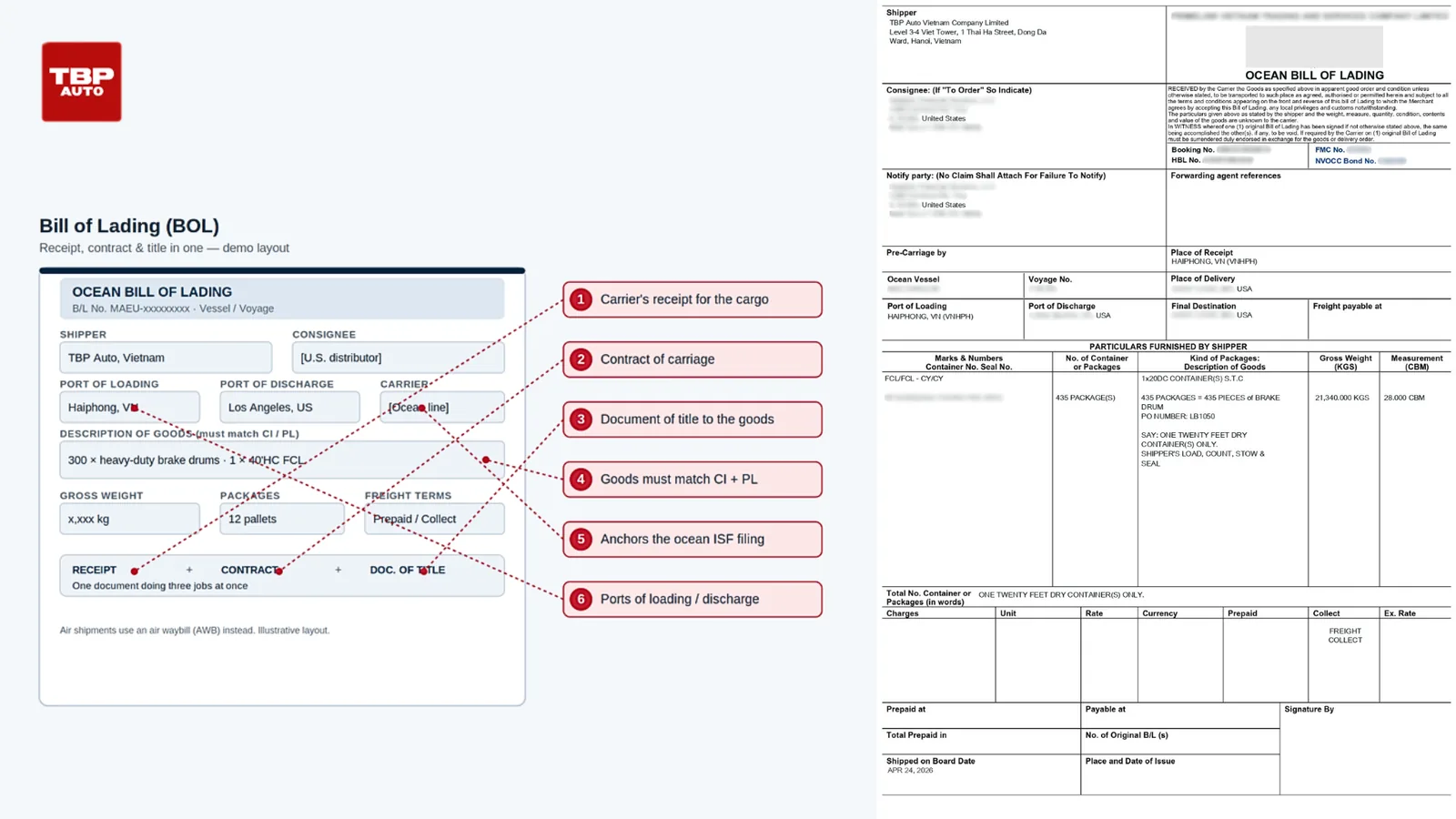
The bill of lading required for the export process is the house bill of lading (HBL), issued by the carrier or freight forwarder once the cargo is accepted for transport.
An HBL typically lists the shipper, consignee, vessel, ports of loading and discharge, container and seal numbers, package count, gross weight, and cargo description.
On an ocean shipment it does three jobs at once: it's the carrier's receipt for the goods, the contract for moving them, and the document of title used to claim the shipment at destination.
The house bill number, assigned at booking, also feeds the Importer Security Filing for U.S.-bound ocean freight, so the two share that reference. The ISF itself is a separate import-side filing the buyer's broker must complete on U.S. CBP's system before the cargo loads.
5. Certificate of Origin
A certificate of origin confirms where the goods were made, which affects customs treatment, compliance, and landed cost.
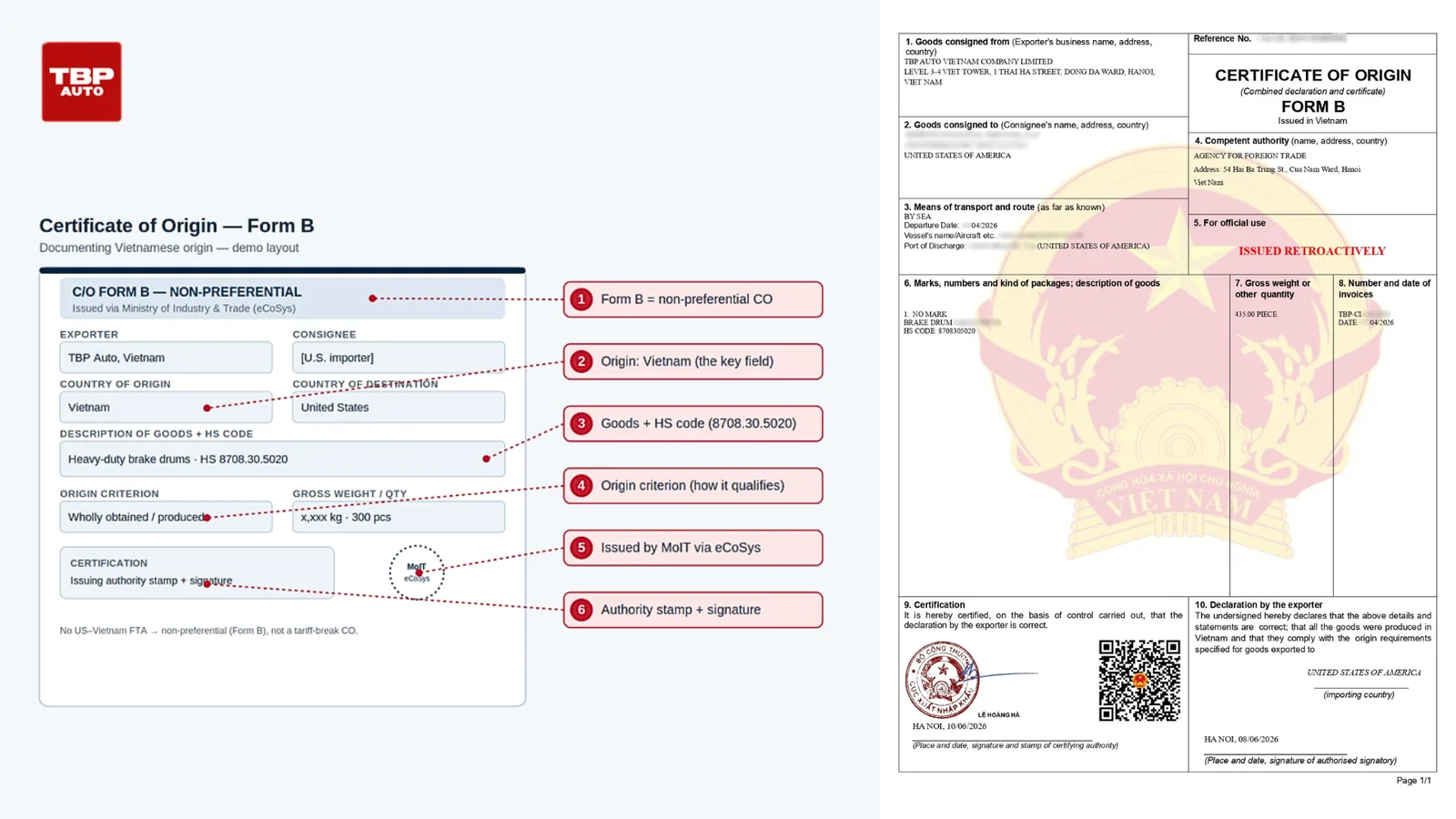
Vietnam-to-US brake drum shipments use a non-preferential CO, known as Form B.
Since 5 May 2025, Form B is issued solely by the Ministry of Industry and Trade through its eCoSys platform; the Vietnam Chamber of Commerce and Industry, which issued it previously, is no longer authorized.
A CO is indispensable for brake drum shipments because it distinguishes Vietnamese-made products from those subject to anti-dumping or countervailing duties in other markets.
Read more → AD & CVD on Brake Drums: How the Duty Math Works
Shipment Support Matters
Export paperwork doesn't have to be complicated, but it does have to be handled carefully. A drum can be well cast and fully certified and still cause the buyer problems if the paperwork is inconsistent or late.
Besides the product itself, TBP Auto also focuses on what it takes to get that product delivered properly. Our experience with export procedures helps customers prepare for customs requirements, reduce avoidable delays, and manage shipments with greater confidence.
From the commercial invoice through the certificate of origin, our export paperwork is prepared to line up with what customs, carriers, and your broker need at the destination.
Interested in a heavy-duty brake drum program with a flexible shipping scheme? Request a quote or contact our team today.