

Introduction
Brake Safety Week 2026 is part of CVSA's Operation Airbrake program, running August 23–29 across the United States, Canada, and Mexico. This year's focus area is the condition of brake drums and rotors. For seven days, inspectors conduct brake-focused roadside inspections and pull any vehicle with a brake-related out-of-service violation off the road until it's repaired.
Why Drums and Rotors, and Why Now
The 2025 numbers show why. Out of 15,175 inspections, 2,296 vehicles were placed out of service for brake violations — a 15.1% rate. Within the drum-and-rotor focus, inspectors logged 113 violations and placed 39 vehicles out of service for rotor and/or drum violations.
CVSA picks the focus area from where the failures cluster, and drums and rotors carry over as the emphasis for a second year running. These problems don't just reduce braking — they create secondary hazards. A worn or cracked component sheds heat poorly, and a piece that breaks off a moving truck becomes road debris at highway speed.
Drum brakes still dominate heavy-duty tractor and trailer axles, while air disc brakes take a growing share of new builds. Mixed fleets will see inspectors checking both this week.
What Inspectors Check on Drums
A roadside check is fast and follows the CVSA out-of-service criteria exactly, the same standard applied during CVSA Roadcheck earlier in the year. Most Brake Safety Week OOS violations come down to a short list, any one of which can deadline the unit.
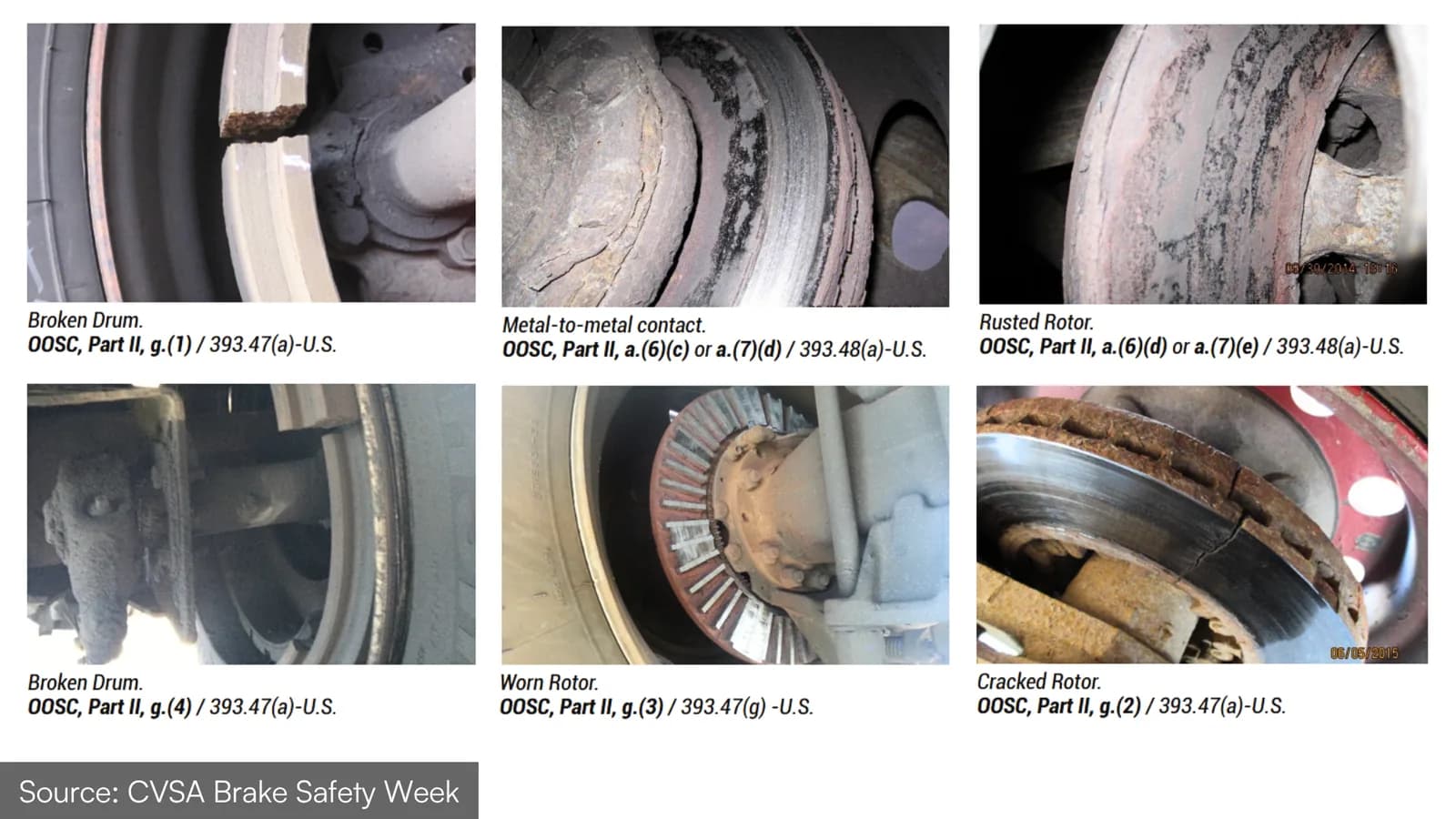
Cracks and missing pieces
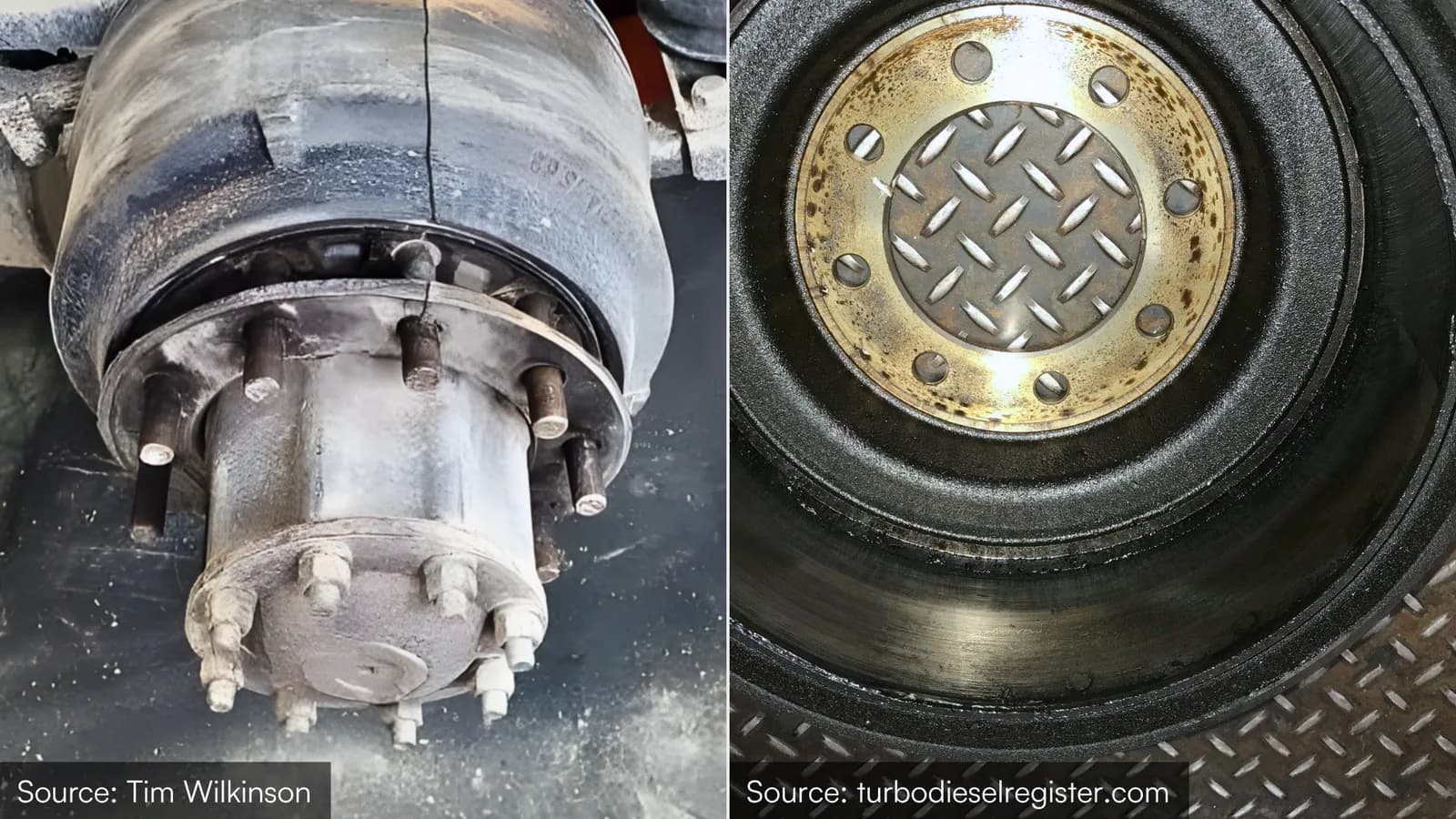
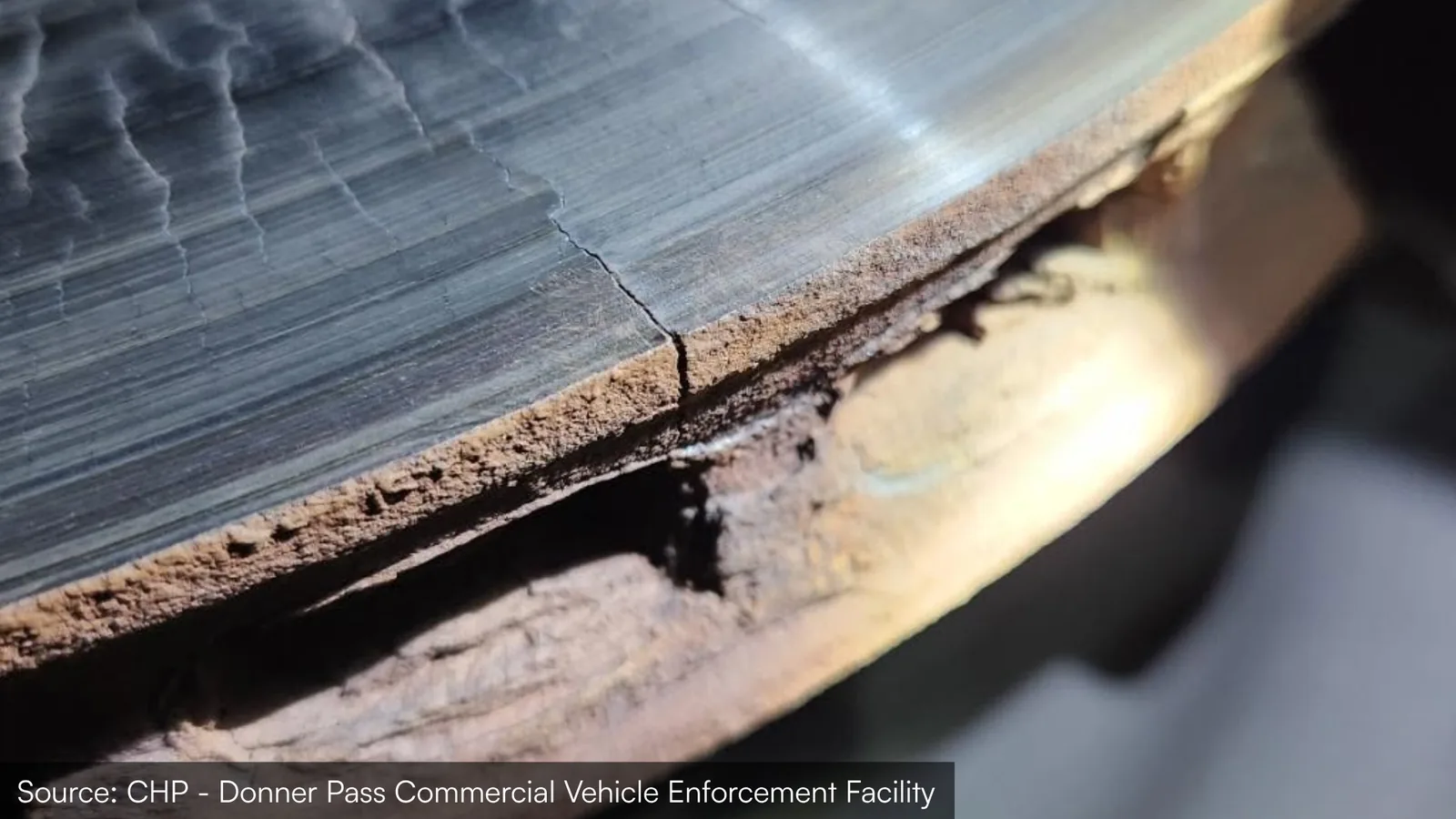
Cracks are the headline item, and the drum criteria are qualitative rather than measured. A drum with an external crack, or with visible cracks that open when the brake is applied, is an out-of-service condition on its own — no measurement involved. So is a drum or rotor with a missing segment, or a piece in danger of breaking off.
CVSA's inspection guidance asks drivers to look for cracks running through to the outer portion of the drum, and for missing pieces where the drum is visible. It also cautions against confusing short hairline heat-check cracks with structural cracks — the two look similar and mean very different things.
Wear past the discard diameter
Every heavy-duty drum has a maximum wear diameter set by the manufacturer. Accuride's Gunite service manual, for example, puts replacement at 0.120″ over the original diameter, with rebored drums finished within 0.080″ — figures that come from the drum maker, not from CVSA, which publishes no numeric diameter limit of its own and instead asks that repairs stay consistent with the brake manufacturer's requirements and guidelines.
That makes the discard figure a shop-floor measurement rather than a roadside one, and it belongs to the specific drum rather than a rule of thumb — which is why a legible discard marking matters.
Heat checking and scoring
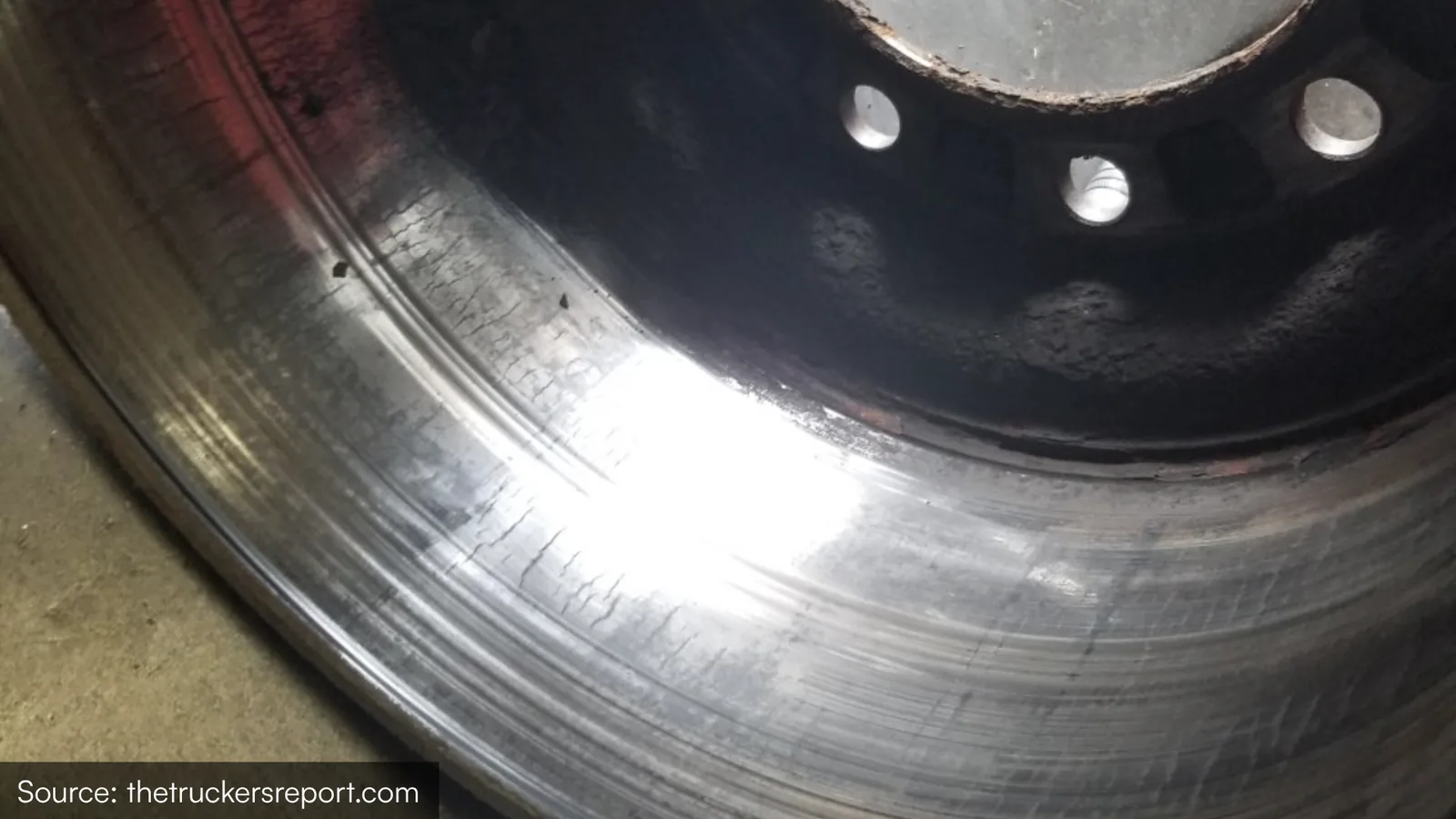
Not every mark is a violation. Heat checking (a fine web of surface cracks from repeated heating and cooling) is normal in small amounts, and only a problem when it deepens toward a structural crack.
Scoring is different: deep grooves from metal-to-metal contact, usually a lining run past its limit, and an out-of-service condition when severe.
Contamination
A drum can measure perfectly and still fail. Oil or grease on the friction surface — often caused by a failed wheel seal — is an out-of-service condition, because the surface can't generate consistent friction and the residue soaks into the shoes.
What Inspectors Check on Rotors
Rotors fail differently, but the criteria follow the same three questions, applied to a disc instead of a drum.
Cracks in the friction surface
CVSA asks drivers to check the rotor's friction surface for cracks and broken pieces, but the out-of-service threshold is specific: the crack has to measure longer than 75% of the friction surface and pass fully through — to the center vent, through a solid rotor, or through a structural support connection for the friction surfaces. A shorter crack, or one that doesn't fully penetrate, is a maintenance decision rather than a roadside violation.
Missing material is the exception. A segment that has broken off, or one in danger of doing so, parks the vehicle on its own with no measurement involved.
Wear to the center vents
A rotor thins as it wears, and it has a hard stopping point: it must never be worn to where the center vents are exposed. As with a drum's discard diameter, the minimum thickness comes from the brake manufacturer rather than a universal figure.
Rust and grooving
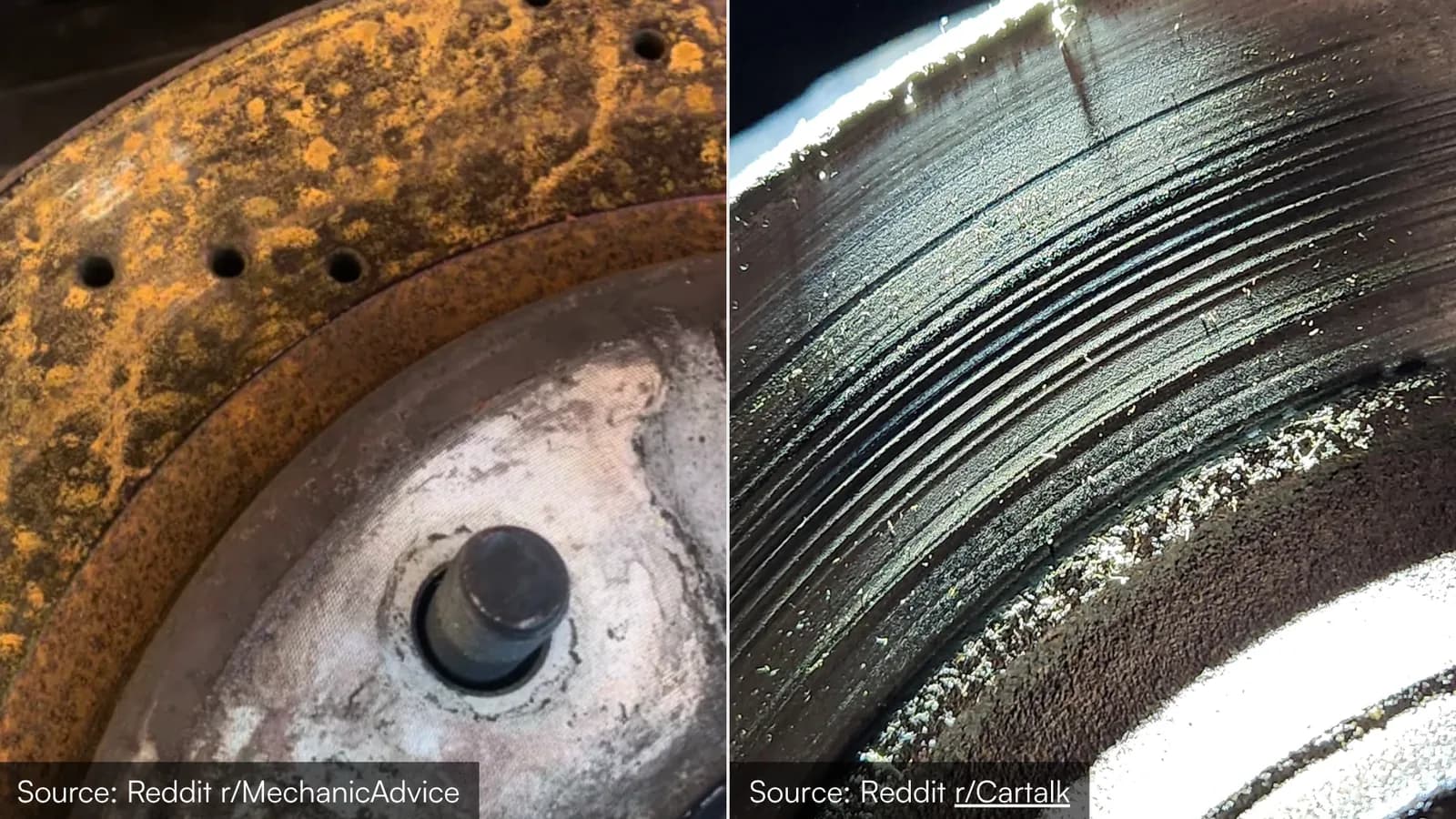
Rust is the one that can be surprising. CVSA's position is direct: heavily rusted rotors across the entire friction surface indicate an inoperative brake. Light rust is fine — it's severe rusting over the whole surface that counts, and it counts as a defective brake rather than a standalone out-of-service item, feeding the 20% defective-brakes calculation. It isn't a cosmetic note: it's evidence that part isn't doing its share of the work. Rusted rotors made up 54 of the 113 drum-and-rotor violations logged in 2025.
Grooving is the other marker. CVSA reads it as metal-to-metal contact — the pads are worn through and the shoe is riding directly on the rotor.
A Checklist Worth Running Before August 23
The fleets that clear Brake Safety Week find these problems in the bay, on their own schedule, rather than at a scale house on someone else's.
| Check | What flags a problem |
|---|---|
| Drum — cracks | An external crack, or visible cracks that open when the brake is applied. Either one is out of service on its own. |
| Drum — wear | Worn past the drum maker's discard diameter — commonly 0.120 in over original (0.080 in when rebored). A shop measurement, not a roadside one. |
| Drum — surface | Fine heat crazing is normal. Deep or spreading checks, severe scoring, or oil contamination are not. |
| Rotor — cracks | A crack longer than 75% of the friction surface that passes fully through to the center vent, a solid rotor, or a structural support. |
| Rotor — wear | Any wear to or through the center vents, or grooving that shows the shoe is riding the disc. |
| Rotor — rust | Severe rust across the whole friction surface (light rust is okay). CVSA reads this as a brake that isn't working at all. |
| Either — missing material | Any chunk broken off, or a segment in danger of coming loose. |
Run this whenever a wheel comes off before late August, prioritizing units on grades or heavy loads. CVSA also asks drivers to check the visible portion of the drum or rotor on pre- and post-trip inspections and log what they find.
Brake Drum Quality Matters
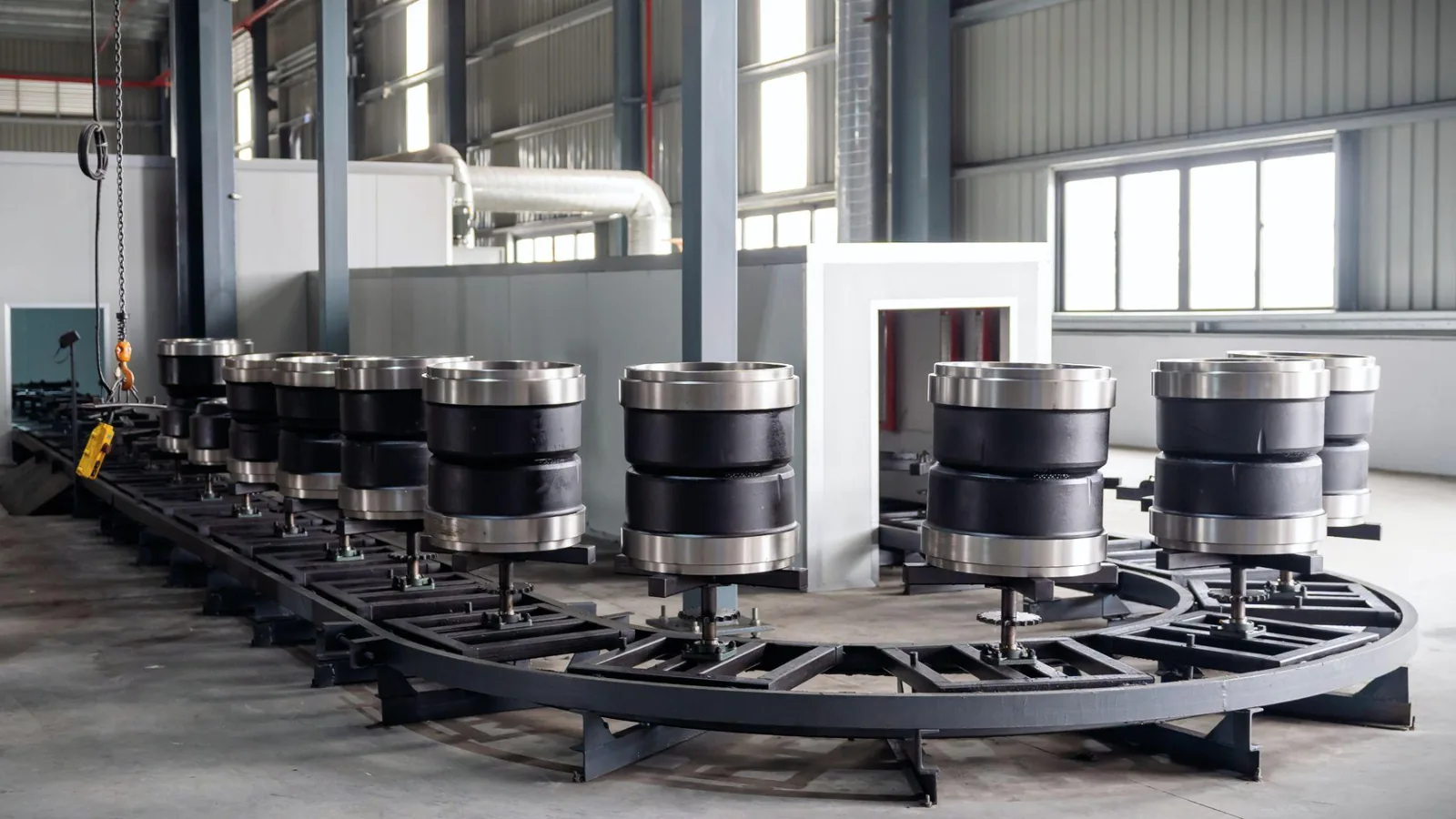
How long a drum lasts depends on duty cycle, brake adjustment, and maintenance. But two things are settled before it reaches your shop: the metal and the machining. High-grade gray iron cast takes repeated thermal cycling before it heat-checks, and resists a check turning into a through-crack.
A drum that ships true, with even wall thickness and low runout, wears evenly and reaches its discard limit on schedule. TBP Auto brake drums are verified on a CMM (coordinate measuring machine) and validated against FMVSS 121 (the federal performance standard for air brake systems) at Link Engineering Company.
If you're stocking drums, our team — Miranda Khuc (Global Sales) and Kevin Kao (Business Developer) — can walk you through specifications and wear-limit documentation. Contact us to learn more.