

Introduction
Once a brake drum order leaves Vietnam, a second set of paperwork takes over — the documents that bring the goods into the United States. Unlike the documents the supplier prepares, this side is the U.S. buyer's responsibility as the importer, usually handled by a customs broker.
This guide walks through those documents in the order they happen, from the broker authorization set up before any shipment to the entry filed when the goods arrive.
These are the import-side documents — the filings the U.S. buyer's broker handles to bring an order into the country, not the commercial invoice, packing list, and certificate of origin the exporter prepares in Vietnam.
The U.S. Import Document Flow at a Glance
For a standard ocean shipment of brake drums arriving from Vietnam, this is the working set in the order each comes into play:
| Document / filing | What it does | Who handles it | Frequency |
|---|---|---|---|
| Importer identity form (Form 5106) | Registers the importer's identity with CBP; required before the first shipment. | Importer (via broker) | One-time |
| Power of attorney (POA) | Authorizes the customs broker to file on the importer's behalf. | Importer (via broker) | One-time |
| Customs bond | A financial guarantee that duties, taxes, and fees will be paid. Required for formal entries ($2,500+). | Importer (via surety / broker) | Recurring (continuous bond covers a year) |
| Importer Security Filing (ISF — “10+2”) | Transmits shipment data to CBP before the cargo loads overseas. | Importer of record / broker | Per shipment (ocean only) |
| Supplier's shipping docs | CI, PL, B/L, CO — prepared on the export side and presented to CBP at entry. | Exporter | Per shipment |
| Import customs declaration (CBP entry) | Declares the goods into the U.S., stating classification, value, and duties owed. Filed in two steps: cargo release (Form 3461) and entry summary (Form 7501). | Importer of record / broker | Per shipment |
Some the importer files, others they receive from the supplier and present at entry. The sections below follow the same order.
1. Importer Identity & Broker Authorization
Before the first shipment ever moves, two things have to be established.
The first is the importer's identity with U.S. Customs and Border Protection (CBP), created or updated through CBP Form 5106. This is what registers the importer of record in CBP's system so entries can be filed under its account.
The second is a power of attorney (POA), which authorizes a licensed customs broker to file on the importer's behalf. Because the entry, ISF, and bond are all filed through the broker, nothing can proceed until this authorization is on file.
Both are one-time setup, established once and then standing for all future shipments. A broker typically handles both during onboarding, and getting them in place early is what lets everything downstream happen on schedule.

2. Customs Bond
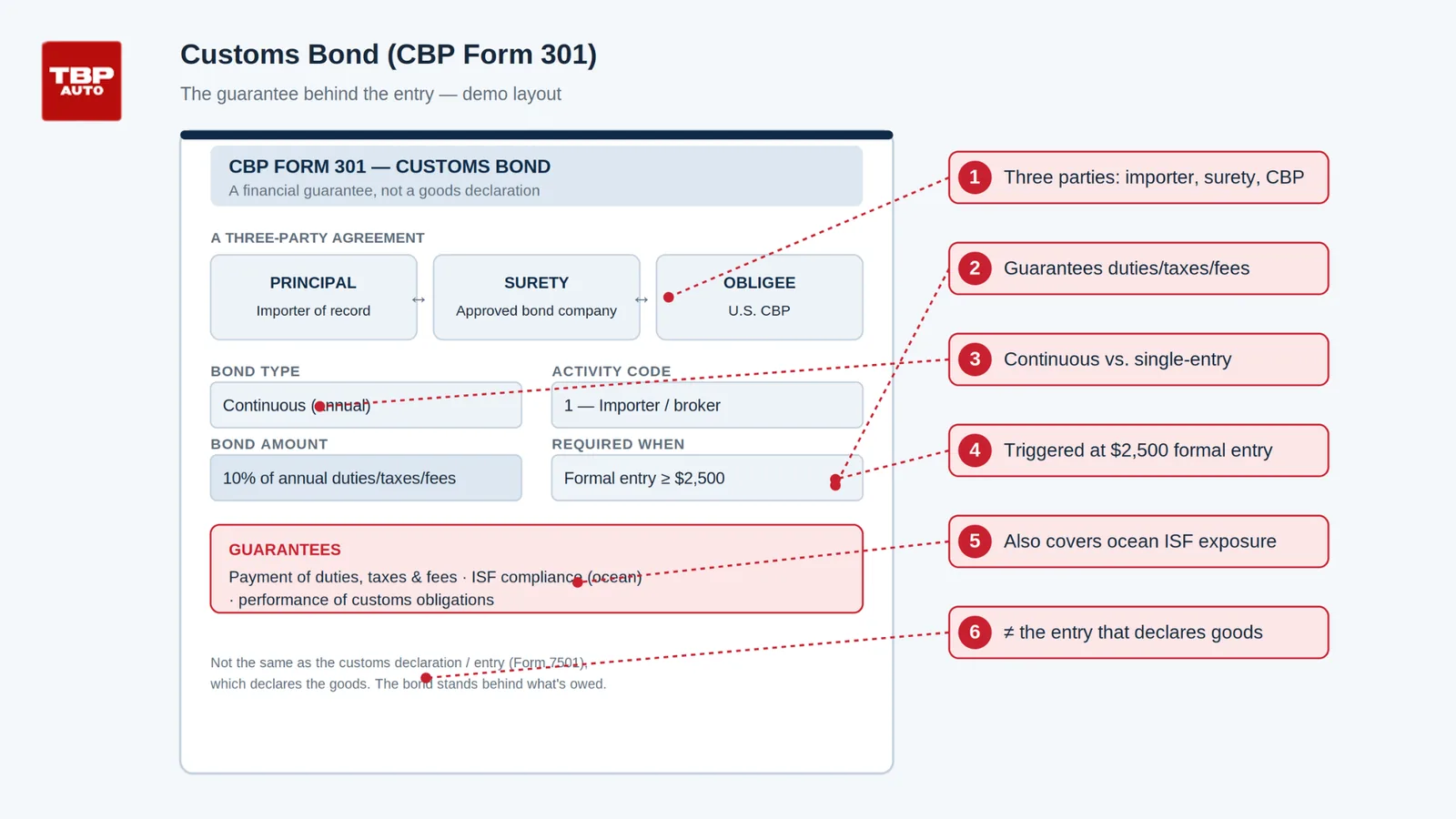
A customs bond is a financial guarantee that the duties, taxes, and fees on a shipment will actually be paid. CBP mandates one for any formal entry — commercial goods valued at $2,500 or more — which a brake drum order easily clears, so a bond is effectively mandatory. It has to be in place before the ISF and entry can be filed.
Importers can use a single-entry bond for one shipment or a continuous bond covering a year, the usual choice for regular importers, and the same continuous bond typically backs the ISF too.
The CBP entry is the filing that declares the goods and assesses the duties, while the customs bond is the separate guarantee that those duties get paid.
3. Importer Security Filing
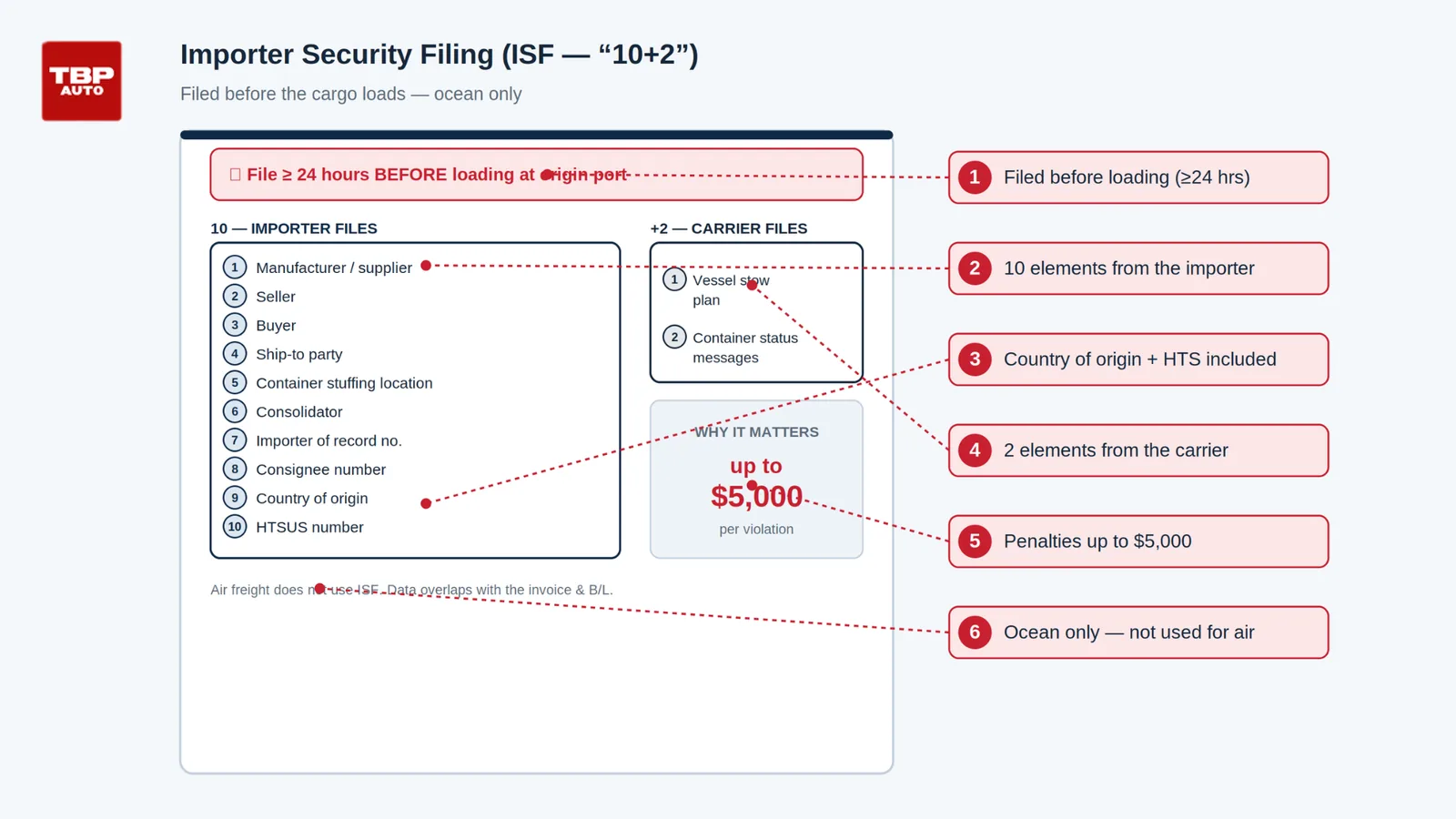
The Importer Security Filing (ISF, or “10+2”) is specific to ocean shipments and is the earliest filing in the process. It's transmitted to CBP before the cargo is loaded onto the vessel in Vietnam.
The “10+2” refers to who provides what. The importer is responsible for ten data elements (manufacturer, seller, buyer, ship-to party, country of origin, HTS number, and others), while the ocean carrier provides two (vessel stow plan and container status).
The ISF must be filed at least 24 hours before loading. Late, missing, or inaccurate filings can draw penalties of up to $5,000 per violation, independent of any issue with the goods.
Much of the importer's information comes directly from the supplier's commercial invoice, so accurate export paperwork is what allows the buyer to file the ISF correctly and on time. It ties to the eventual bill of lading through the lowest-level house bill number, assigned at booking.
4. The Supplier's Shipping Documents
As the goods are prepared, loaded, and shipped, the supplier prepares the export documents that travel with them: the commercial invoice, packing list, bill of lading, and certificate of origin.
While the importer doesn't create these, their broker presents them to CBP at entry, so their accuracy is what keeps the buyer's clearance smooth.
The B/L also serves as evidence of the right to make entry, and the CO proves the drums are Vietnam-made.
In August 2025 the U.S. issued anti-dumping and countervailing duty orders on certain brake drums from China and Türkiye. Vietnam-made drums aren't covered by those orders. The supplier's CO is critical because it changes your duty math and landed cost.
Read more → AD & CVD on Brake Drums: How the Duty Math Works
5. Import Customs Declaration
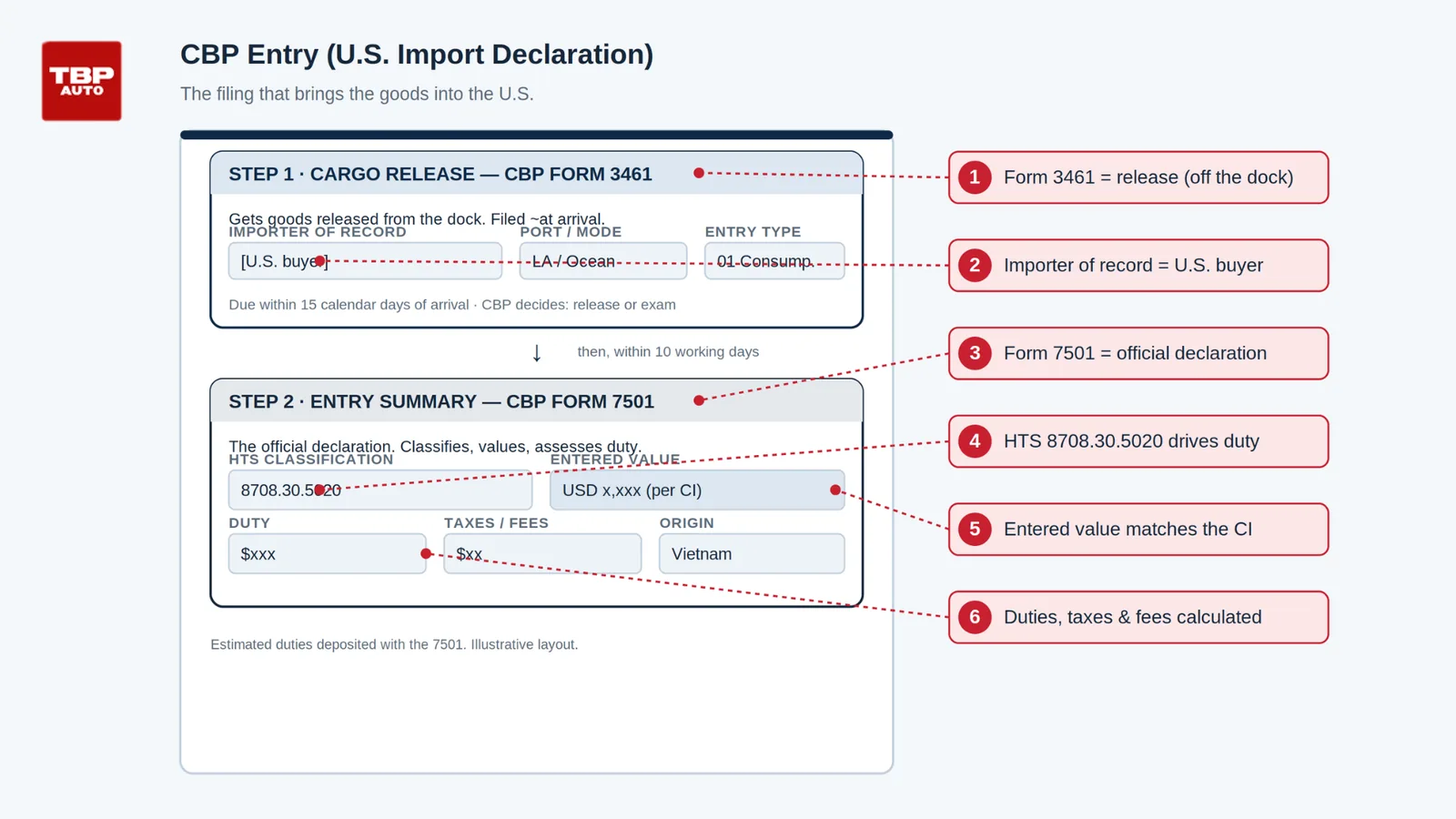
When the shipment reaches the U.S., the CBP entry declares it in — the filing that tells Customs what the goods are, what they're worth, how they're classified, and what's owed. It comes in two steps:
- Cargo release (CBP Form 3461). Submitted around arrival, with the essentials — importer of record, goods description, port, mode — so CBP can release the shipment or hold it for exam. Due within 15 calendar days of arrival.
- Entry summary (CBP Form 7501). The official declaration that follows, which carries the full HTS classification (8708.30.5020), entered value, and duty calculation. Filed within 10 working days of release, with estimated duties deposited then.
The HTS code and entered value on the 7501 drive the duty total. The entered value is built from the supplier's commercial invoice, with adjustments for the terms of sale, so the entry has to reconcile cleanly with the export paperwork — discrepancies invite CBP scrutiny.
Who Pays the Duties
Estimated duties, taxes, and fees are paid to CBP with the entry summary, the bond standing behind that payment.
Who bears the cost depends on the Incoterm: on FOB or CIF terms the buyer pays as importer of record; under DDP the seller takes them on. Either way, it's separate from paying the supplier for the drums, which is a commercial matter set by the sales contract.
DOT HS-7: A Possible Agency Declaration
Beyond the core filings, auto parts enter under tariff lines the National Highway Traffic Safety Administration can flag. Depending on the classification, the broker may also need to file a DOT HS-7 declaration, often simply to state the equipment's regulatory status. Whether it's requested varies by shipment, one more reason accurate classification matters.
Working With TBP Auto
At TBP Auto, we prepare the export-side documentation — commercial invoice, packing list, export declaration, bill of lading, and certificate of origin — that your customs broker needs to complete the U.S. entry, ISF, and bond. We also supply the manufacturer and seller details your ISF filing requires, information only the supplier side can provide.
Beyond the paperwork, TBP Auto is ready to advise on the full shipping process, including how responsibilities shift under different Incoterms so you know what falls to you and what we handle.
If you're evaluating TBP Auto brake drums for your fleet or catalog and want to walk through the paperwork for your shipment, reach out to our team and we'll get you what you need.